What’s hard? What’s heavy? What’s effective? Those questions pop up all the time, and there is no simple answer. The answer always ends up being “Well, it depends.” People want things to be simple and they are not. Maybe that is why they are easily fooled and buy into gimmicks and falsehoods so easily and get conned by every Instagram “expert.” One can easily take a tidbit of info and distort it into something it isn’t.
I’ve had people get offended when I’ve selected a warmup weight for them and say we are starting light. People actually yell at me, “What do you mean light? This is hard.” I didn’t say it wouldn’t feel hard, but in weight training terms it is light. I get a confused look. In lifting terms, if you can lift something 15 times before you fail, it is light. It may be hard for a beginner or novice, but it is light. In fact, a beginner or novice doesn’t even have the ability to go to actual failure. Even so, it is still light. The problem is not knowing what you don’t know. There has been no experiential learning. This goes on at all levels.
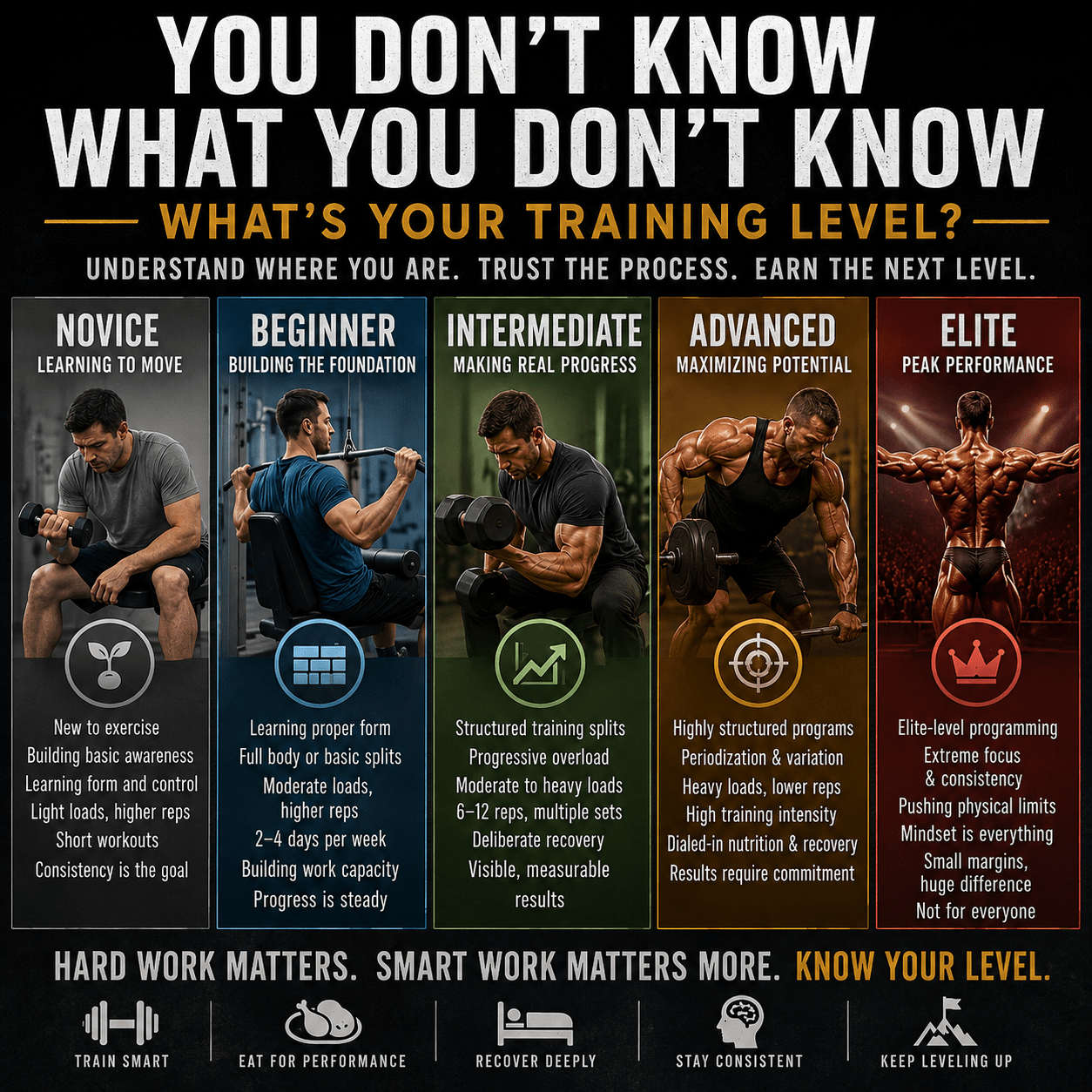
Below I’ve mapped out my own personal training level “theory,” based on 45 years of working with people at virtually every level of ability, combined with my own progression through these levels as an athlete. I’ve experienced these stages from both sides—under the weight myself and standing beside thousands of sets watching other bodies adapt, struggle, compensate, progress and sometimes regress. Daily I seem to deal with the issue that people overestimate the actual level at which they are training, in their current state of fitness, what it will take to get where they want to be, and the mismatch between wants and willingness to do what it takes to reach their goals.
I’ve divided training levels into 5 levels: Novice, Beginner, Intermediate, Advanced, and Elite. Within each level there are stages, and certain nuances that help to gradually take the trainee to the next stage of advancement.
Novice: The usual novice exerciser is new to any form of exercise and completely deconditioned. This person usually lacks body awareness and doesn’t possess a reference point to judge the difficulty or level of exertion they are experiencing. Lifting anything other than air seems hard and heavy. They tend to not be able to control the execution of a lift, even at the lightest level. Movement is unbalanced. Control of the negative portion of the movement is far away. I’ve spent months with a person just trying to get them to lower a pair of dumbbells without dropping, swinging and relaxing at the bottom, or to be able to stretch in a lat pulldown without going to a full-blown bouncing dangle in the stretch. Surprisingly, some novice lifters are not totally new to exercise, they’ve just never progressed for various reasons. I’ve worked with people who’ve been stuck in this novice mode for years, because they’ve never learned how to lift properly, or were big believers in some of the common weightlifting myths. People trapped in this mode are the hardest to train, as they’ve spent a long time with bad habits. Many elderly people fit in this novice category. They’ve had a lifetime of sedentary habits and are now trying to eke out whatever movement they can to avoid a wheelchair. Most are in an incredible amount of pain due to weakness and bad posture. Novice exercisers often become nauseous or light-headed with any level of exertion. Many novice lifters can only handle 1-2 sets of a very light circuit of weights, or band training. This in itself seems incredibly hard.
Beginner: A basic Stage 1 beginner lifter sometimes has past experience with some form of exercise. Maybe they were never taught proper form, but they have a little better control of body movement. A beginner session might be a full-body circuit of 12 exercises, 2-3 sets each, performed 2-3 times per week. This might look like the following: Incline Dumbbell Chest Press, Machine Pec Dec Fly, Lat Pulldown, Seated Row, Overhead Press Machine, Dumbbell Lateral Raise, Triceps Pressdown, Dumbbell Curls, Leg Extension, Seated Leg Curl, Leg Press, Ab Machine Crunches. This is just a sample. Some people choose to stay at the beginner level for many reasons. Maybe they are only interested in mild body changes and keeping mobile as they get older. Progress eventually plateaus even with active attempts to progress, as the time under tension is limited per body part. A Stage 2 beginning program involves splitting the body in half. This can be done in many ways: Chest/Shoulders/Triceps then Legs/Back/Biceps… or possibly Chest/Back/Triceps then Legs/Shoulders/Biceps (more conducive to super-setting). Either of these options would likely involve 3 exercises for each of the major larger muscle groups and two for the arm movements. The number of exercises has decreased, but the sets will increase to 4 not including warm-up. This will increase the time the specific muscle is under tension in the workout. This split is generally performed twice a week, 4 workouts per week, for an hour. Once a plateau hits, progress generally requires adding additional exercises. Eventually, the workout would require 1.5 hours or more. Still with this split, the legs will be lacking in exercise volume. A Stage 2 beginner more interested in progress in the lower body may prefer an upper/lower body split. Upper body day would be a full-upper body circuit. The following sequence could be used in a super-set manner: Flat Bench Dumbbell Press/Wide-grip Lat Pulldown; Incline Bar Press/Seated Row Machine; Pec Dec Fly/Rear Delt Fly; Overhead Press Machine/Upright Row; Dumbbell Lateral Raise/Dip Machine; Triceps Pressdowns/Bicep Curls, Abs. Each workout should have different exercises and variations, performed for 3 sets. This is a general conditioning upper body program. As endurance improves the rest between sets will decrease. At some point, depending on the person, strength increase and muscle gain will plateau, as once again, the amount of time under tension for each muscle group is limited. The lower body part of the split will generally fare better as the entire workout is devoted to legs, and depending on the individual’s ability to push themselves, this workout can see continued progress for much longer, taking a person into an intermediate level. A typical workout may be Leg Extension, Leg Curl, Squat, Leg Press, Abductor/Adductor, and Hip Bridges. The intensity and difficulty will depend on the weight, rest period, number of sets and whether the person is able to train to failure. Throwing in walking lunges, split squats, step ups, etc. and/or performing supersets can take this workout to the next level.
Intermediate: The intermediate trainee’s program can have several levels depending on how many days per week the person works out, and many different splits. If the trainee continues with the A,B – A,B workout sequence in the past level, then the number of sets must increase, as well as the total workout time, from 1 hour to 1 1/4 or 1 1/2 hours. One natural progression would be the A,B,C split, working out 3-5 days per week. This might be formatted as Chest/Back, Shoulders/Biceps/Triceps; Legs/Calves/Abs. With this workout supersetting works well, pairing 4 chest exercises with 4 back; or 4 shoulder movements with 2 biceps/2 triceps movements, then doing a full Leg Workout as before. Once past the initial adjustment period to supersetting heavier major movers, the natural progression to stay on this split would be to increase the number of training days to 5. This sequence would look like A,B,C, rest, A,B, rest, rest, C,A,B, rest, C,A, rest, rest… and so on. Another intermediate split would divide the body into 4 sections. Depending on the trainee’s goals and needs, there are countless ways to format this. One split I am currently using with a client is as follows: A) Chest/Upper Back/Rear Delt; B) Legs/Calves; C) Shoulders/Biceps; D) Back/Triceps. I chose to split this way for specific reasons. I wanted to focus on scapula/shoulder stability. The client came to me with a left shoulder injury and a right shoulder that was very unstable. He had recently injured his neck and had several biomechanical issues that kept him from engaging the muscle properly, yet he had a long history of working out. Once we moved past the A,B and the A,B,C split I chose to follow this sequence, which would give me more time to address the scapula/shoulder stability. A) workout involves 3-4 chest exercises and 3 upper back/rear delt exercises B) Legs remain the same as before C) 3-4 shoulder exercises and 3 biceps exercises D) 3-4 back exercises and 3 triceps exercises.
Sample A) 1) Incline Dumbbell Press superset with Face Down Rear Delt Fly
2) Bench Press superset with Wide-Grip T-Bar Row (performed pulling
focusing on upper back/rear delt)
3) Cable Fly superset with Face Pulls
If time permits: Chest Dips superset with Ab Leg Raises
B) 1) Leg Extension/Lying Leg Curl
2) Squat
3) Vertical Leg Press/Seated Calves
If time permits: Walking Lunges
C) 1) Overhead Dumbbell Press/Alternating Dumbbell Curls
2) Overhead Press Machine or Smith Press/Bar Curls
3) Lateral Raises/Cable Double Bicep Curls
If time permits: Upright rows/Abs
D) 1) Close-grip Pulldowns/Triceps Pressdowns
2) Wide-grip Chins/Lying Triceps Extensions
3) Seated Cable Row/Dips
If time permits: High Hammer Row/Overhead Cable Extension
You will notice that on my primary Chest/Rear Delt Day (A), I do get activation of the Lats and Rhomboids. And on my primary Back/Triceps day (D), I get activation of the pecs by including dips. This is programmed this way intentionally. During this program, we are focusing on stabilizing the shoulder and maintaining positioning through heavier lifts. The natural progression of this program would be to gradually shorten rest periods, allowing for the 4th exercise pairing in each upper body routine. Then adding a day 5, another leg day. The second leg day would include Deadlifts, Bulgarians, and other movements not done on the first leg day.
Taking sets from 4 to 5 or more (not including warmups), adding the 2nd leg day, and a few drop sets would gradually take the workout into more of an advanced level.
As you can see, we’ve only gotten to the Intermediate level, and training programming and progression is far more complicated than the lay person will comprehend. I would like to note that this is also why looking at someone else’s training program on paper, without understanding the history behind it, can be misleading. An exercise, training split, number of sets, or frequency can look right or wrong depending on the lens through which you are viewing it. What isn’t visible on paper is what I am seeing while the person is training: how the scapula is moving, where the shoulder is drifting, which muscles are failing to engage, where compensation begins, what happens as the weight gets heavier, and how all of that has changed over the preceding weeks and months. A program is not simply a list of exercises. It is a progression. What I am doing with someone today may be specifically designed to prepare them for what I intend to have them doing three months from now. Pulling one piece out of that progression and evaluating it independently misses the point. This is one of the problems I see when people outside the training profession offer training advice based on a study, an article, or their own personal workout experience. Expertise in nutrition, medicine, chiropractic care, physical therapy, or another health-related field certainly brings valuable knowledge to the table, but expertise in one discipline does not automatically create expertise in another. Good professionals should be able to work together while also recognizing where one person’s area of expertise ends and another’s begins.
Advanced: The Advanced lifter has usually spent many years getting here. Most gym goers never make it to this point, only some of the gym rats who take their training seriously, and some competitors. By this point the average advanced lifter trains 6 days/week. The program format usually involves training one body part per day, such as: Chest; Back; Legs: Shoulders: Arms; Legs. The two separate leg days would have different emphasis, as before. The upper body workout days generally have 5-7 exercises on that one muscle group, at least 5 sets each, going by instinctive training needs. Some trainees might add 1-2 Triceps movements to their Chest Day, and 1-2 Bicep movements to their Back Day, since this would still allow adequate rest before the arm-focused day. Also, an option is to add in extra work on weak body parts. For instance, if the front delt is underdeveloped, add 1-2 front delt exercises to the Chest day. Drop sets and supersets are sometimes deployed. I don’t put a time on an advanced-level workout; you are done when you are done.
Elite: Few people understand what elite training entails. I hate to say it, but in this day and age, I rarely see it. Old school training was brutal in comparison to what is done now. The trend of today is chemical enhancement and not getting to the elite level by utilizing advanced training techniques and sheer power, strength, and consistency. For the most part, elite training is reserved for people under 50. By that age, the body, without chemical enhancement can’t recover enough, and we all seem to be forced to back off a bit. Of course there are exceptions out there, but they are unicorns. Many can still train at an advanced level, but elite training is far more treacherous. In my elite training days, I worked out with the guys in the “Squat till you puke” sessions. At least 12 sets, with heavy loading. After my set of heavy squats, I would do a full giant set around the gym, 5 or 6 isolation movements, often strip setting the entire weight stack, then come back and do my next set of heavy squats. Then I did heavy bar lunges, hack squats, leg presses, and stiff-legged deadlifts standing on the end of a bench stretching below my feet. The upper body workouts were just as grueling, combining power movements with triple drop sets, and giant sets. I always compared elite training to walking a very fine tightrope. You had to have this level of intensity to get real muscle growth after so many years of training, and to continue the progress to become an elite athlete. Yet, it was very easy to slip over the line. Walking the edge, however, was a necessary course.
So why do people remain stuck at a level? There is often a disconnect, or broken link.
The disconnect between beliefs, feelings, and reality can sometimes become a thorn in your side, as well as your trainer’s. What do I mean by that? Misguided beliefs, feelings based on nothing but feelings, and the disconnect between the reality of where you are right now, and the commitment required to move you forward, often prevent you from actually getting there.
It is the person who shows up for their workouts, but only changes their diet for a week, then goes back to old habits and expresses their frustration as “Nothing is working.” This applies to alcohol consumption as well. Instead of inconsistency with their diet as the culprit, they blame the workout. It is the same story with the person who does cardio for a few days, then stops, expecting big changes from minimal effort.
It is the person who has biomechanical issues but gets angry when corrected because retraining your body out of bad habits is frustrating Yet not doing so will ultimately lead to injury and regression, not progression.
It is the person who trains for years at the novice level in terms of frequency and lack of body awareness. They refuse to acknowledge their own role in being stuck, because they’d rather believe an Instagram post claiming that someone put on 12 lbs. of muscle working out as a novice. Their diet may be dialed in, but the training remains stagnant. A trainer can only take a person, and they can only go, where their body is prepared to go. Yet they are constantly looking for a “cleanse” or magic supplement that will help them lean out or build muscle when the real issue is the lack of a time commitment.
Remembering that you are responsible for your progress is important for all growth. Your trainer is the voice of expertise and your guide. Sometimes it is necessary to “rip the Band-aid off” to uncover the emotional or physical affliction that limits you. Left covered and unaddressed, that affliction can infect far more than the original wound, influencing your beliefs, your choices, and ultimately your ability to move forward.
Again, I find the main problem in understanding the different training levels, is that you don’t know what you don’t know. If you haven’t experienced it, you don’t know. Every person, at every level, thinks they are training at a very difficult level and intensity. And for the most part, they are, but just for the level their body is at, at that point in time.
I often laugh at some of the literature I read. A client actually brought in an article that claimed a woman put on 12 lbs of muscle in 8 weeks of training 2x/week, basically at a novice/beginner level. That is just not going to happen. Then there are the somewhat legitimate research articles. One announced that the A,B rest A,B workout put on more muscle than the Bro’ Split (one body part per day) because the muscle reacted better to the twice per week training. Well, there are many variables here. What were the Bro’s doing in their Bro’ split? How many reps, sets, weights… technique? What level were they? Were they untrained or a beginner? Were they lifting the same weights, rep ranges, and time under tension for each muscle group? Too many variables to make that assumption. From my many years of experience, when you drop down to a lower level of training, you eventually drop down in muscle fiber and strength. Women decondition and drop much faster than men, due to hormones and genetics. Men will vary based on their natural genetics. If a man is genetically gifted, he will maintain conditioning much longer than a man who is not. (Note: this genetic factor also applies to the variance of where any of the above levels of training will take you.)
On a personal level, I’ve seen this ebb and flow in my own conditioning and training. In times where I’ve backed off to 4-5 days per week of training, I gained body fat and lost strength and muscle, even though I was trying my best to use the same level of resistance. Decreasing the number of sets led to a decrease in muscle, whether I was training 5x week or 6. It was gradual, but eventually very apparent. A woman holding as much muscle as I do, will not find it easy to maintain, as it is a rather unnatural state of being for a woman, not having the hormone balance that perpetuates this. I was watching a YouTuber discuss a study claiming that after you stop training, it takes several months before muscle loss occurs. I don’t know what world this person lives in, but I’ve seen this countless times over my 45 years of training. A client will work out hard for a year, make great progress, gain muscle and strength, then disappear for several months. They come back looking like they had never set foot in a gym before. I call BS again on this one, especially since I measure body fat and have concrete proof that muscle loss definitely occurs.
The moral of the story? There are several. Nothing in life worth having comes easy. Nothing is free. There are no shortcuts. Use it or lose it.
But maybe the bigger lesson is to understand that you don’t know what you don’t know.
Something can be hard without being advanced. Something can feel heavy without being heavy in training terms. A workout can exhaust you without necessarily being the workout that will take you where you want to go. And an exercise or program that makes no sense when viewed by itself may make perfect sense when you understand where the person started, what problem is being corrected, and where the program is taking them.
Forty-five years in this business has taught me that the more you truly learn about training, the less simple it becomes. Every body brings a different history to the gym. The art is knowing what to do with the body standing in front of you.
We can all strive for excellence. But first we have to understand where we actually are.